Irrigation Water as a Physicochemical and Biological System
written by

Agricultural Irrigation Specialist with hands-on experience in crop, vegetable, and orchard production, focused on maximizing yields and managing teams, machinery, and technical reporting. Combines scientific principles with practical, on-site fieldwork implementation
Subscribe to our monthly water newsletter
We might send you an email if we have something news worthy, written by our water professionals
From an agronomic perspective, water quality is therefore not a single parameter. It is the combined result of physical, chemical and biological properties, and these properties continue to interact after the water enters the irrigation system and soil.
EC and salinity: concentration matters, but so does composition
Electrical conductivity (EC) is a proxy for the concentration of dissolved ions in water. As ionic concentration increases, electrical conductivity generally increases.
FAO (Food and Agriculture Organization) guidance commonly uses 0.7 dS/m as a reference below which salinity-related restrictions are relatively limited for many conventional irrigation situations. Between approximately 0.7 and 3.0 dS/m, increasing attention to crop tolerance, soil properties, drainage and management is required. Higher values can impose substantial limitations, but there is no universal EC threshold that defines suitable irrigation water for every crop.
This distinction is important because EC describes the total ionic environment, not which ions are present. Two waters with the same EC may have very different concentrations of sodium, chloride, calcium, magnesium or bicarbonate and therefore very different agronomic consequences.
Salinity also directly affects plant-water relations. Increasing salt concentration lowers the osmotic potential of the soil solution, reducing the gradient that drives water into the root.
Consequently, high soil moisture does not necessarily mean high water availability to the plant. The soil may contain sufficient water while the root experiences physiological water stress because extracting that water requires a greater energetic and osmotic gradient.
Oxygen: the physical link between irrigation and root metabolism
Water content also determines how effectively oxygen can reach the root zone.
Molecular oxygen diffuses approximately 10,000 times more slowly through water than through air. As irrigation fills air-containing soil pores with water, gas diffusion decreases sharply. If oxygen consumption by roots and microorganisms exceeds its rate of replenishment, hypoxia can develop even though the soil contains abundant water.
This has direct consequences for roots because aerobic respiration provides ATP required for cellular maintenance, growth and active membrane transport.
But oxygen availability also affects something broader: the microbial and chemical state of the rhizosphere.
Oxygen determines which microbial metabolisms are possible
Microorganisms require electron acceptors to obtain energy.
Under aerobic conditions, oxygen is the preferred terminal electron acceptor for many soil microorganisms because aerobic respiration provides a high energetic return.
When oxygen becomes depleted, facultative and anaerobic microorganisms can begin using alternative oxidised compounds.
As reducing conditions develop, a characteristic sequence can occur:
O₂ → NO₃⁻ → Mn(IV) → Fe(III) → SO₄²⁻
The exact sequence and rate depend on pH, temperature, organic-carbon availability and soil conditions, but the principle is fundamental: changing oxygen availability changes microbial metabolism, and microbial metabolism changes soil chemistry.
This is why oxygen deficiency cannot be considered purely a root-respiration problem.
It is also a biogeochemical problem.
DO and ORP describe different parts of the same system
Dissolved oxygen (DO) measures the concentration of molecular oxygen in water.
Oxidation-reduction potential (ORP or Eh) describes the tendency of an environment to accept or donate electrons and therefore provides information about its redox state.
They are related but not equivalent.
As oxygen is consumed, ORP generally moves toward more reducing conditions. Microbially mediated reactions can then alter the chemical state and mobility of nitrogen, manganese, iron and sulphur.
Research on waterlogged soils shows that oxygen depletion is followed by denitrification and progressively more reducing transformations of Mn, Fe and sulphur compounds.
For irrigation and root-zone assessment, this means that DO, ORP, pH and EC provide more information together than any of these parameters provides individually.
Microbiology and nutrient availability are closely connected
The rhizosphere is not simply soil containing roots. It is a highly active interface in which root exudates provide carbon substrates for microorganisms and microbial activity modifies nutrient availability.
A meta-analysis of 123 studies found that available nitrogen was approximately 10% higher in the rhizosphere than in bulk soil, while microbial population densities were substantially higher around roots.
At the same time, available phosphorus was lower, reflecting strong competition and biological demand within this zone.
Therefore, describing soil biology simply as “more microorganisms = better soil” is scientifically inadequate.
What matters is the composition and functional activity of the microbial community, together with the physical and chemical conditions that determine which metabolic processes dominate.
Oxygen is one of those controlling conditions.
The same interactions occur inside irrigation systems
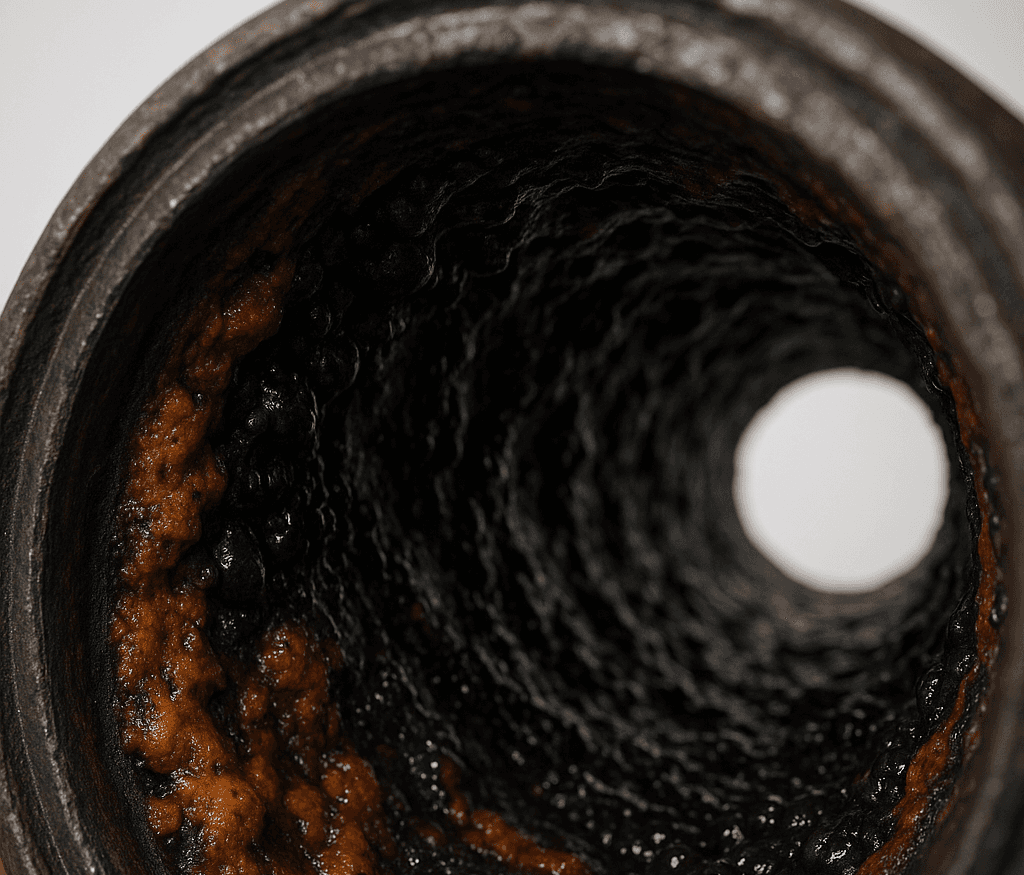
Before water reaches the soil, physical, chemical and biological processes are already interacting inside tanks, pipelines and emitters.
Drip-irrigation clogging is conventionally divided into three categories:
Physical: suspended particles and sediment deposition.
Chemical: precipitation of dissolved minerals.
Biological: microbial growth and biofilm formation.
In practice, these mechanisms frequently overlap. Biofilms can trap mineral and clay particles, while nutrients and organic carbon in irrigation water support microbial growth.
A major review of drip-irrigation systems describes clogging as simultaneously physical, chemical and biological, with water quality determining the risk and dominant mechanism.
Biofilm itself is not simply accumulated dirt. It is an organised microbial community embedded within extracellular polymeric substances.
Within the same biofilm, oxygen gradients can develop as organisms near the water interface consume oxygen before it diffuses into deeper layers.
Even at the scale of millimetres, therefore, different microbial metabolisms can coexist.
Good irrigation water cannot be defined by one number
The scientifically relevant question is not whether irrigation water is simply “clean”.
It is whether its physical, chemical and biological characteristics are compatible with the crop, irrigation system and root-zone environment.
A useful assessment therefore combines:
EC and ionic composition — to understand salinity and specific-ion risks.
pH and alkalinity — to understand chemical equilibria and precipitation potential.
DO and ORP — to understand oxygen availability and redox conditions.
Turbidity and suspended solids — to assess physical loading.
Organic matter and microbial activity — to evaluate biological loading and biofilm potential.
Temperature — because it affects oxygen solubility, microbial activity and chemical reaction rates.
These parameters are not independent. Water content controls oxygen transport. Oxygen influences microbial metabolism. Microbial metabolism changes redox chemistry. Redox chemistry changes nutrient and metal behaviour. Salinity influences water uptake.
And all of these processes converge in the rhizosphere.
That is why irrigation-water quality should be understood not as a collection of isolated measurements, but as a dynamic physicochemical and biological system.