written by

Agricultural Irrigation Specialist with hands-on experience in crop, vegetable, and orchard production, focused on maximizing yields and managing teams, machinery, and technical reporting. Combines scientific principles with practical, on-site fieldwork implementation
Subscribe to our monthly water newsletter
We might send you an email if we have something news worthy, written by our water professionals
For growers, understanding the endodermis helps explain why root-zone conditions matter so much. The plant does not simply take everything that is present in the water or growing medium. It actively regulates the movement of water and dissolved ions before they reach the xylem and are transported throughout the plant.
From the root zone to the plant
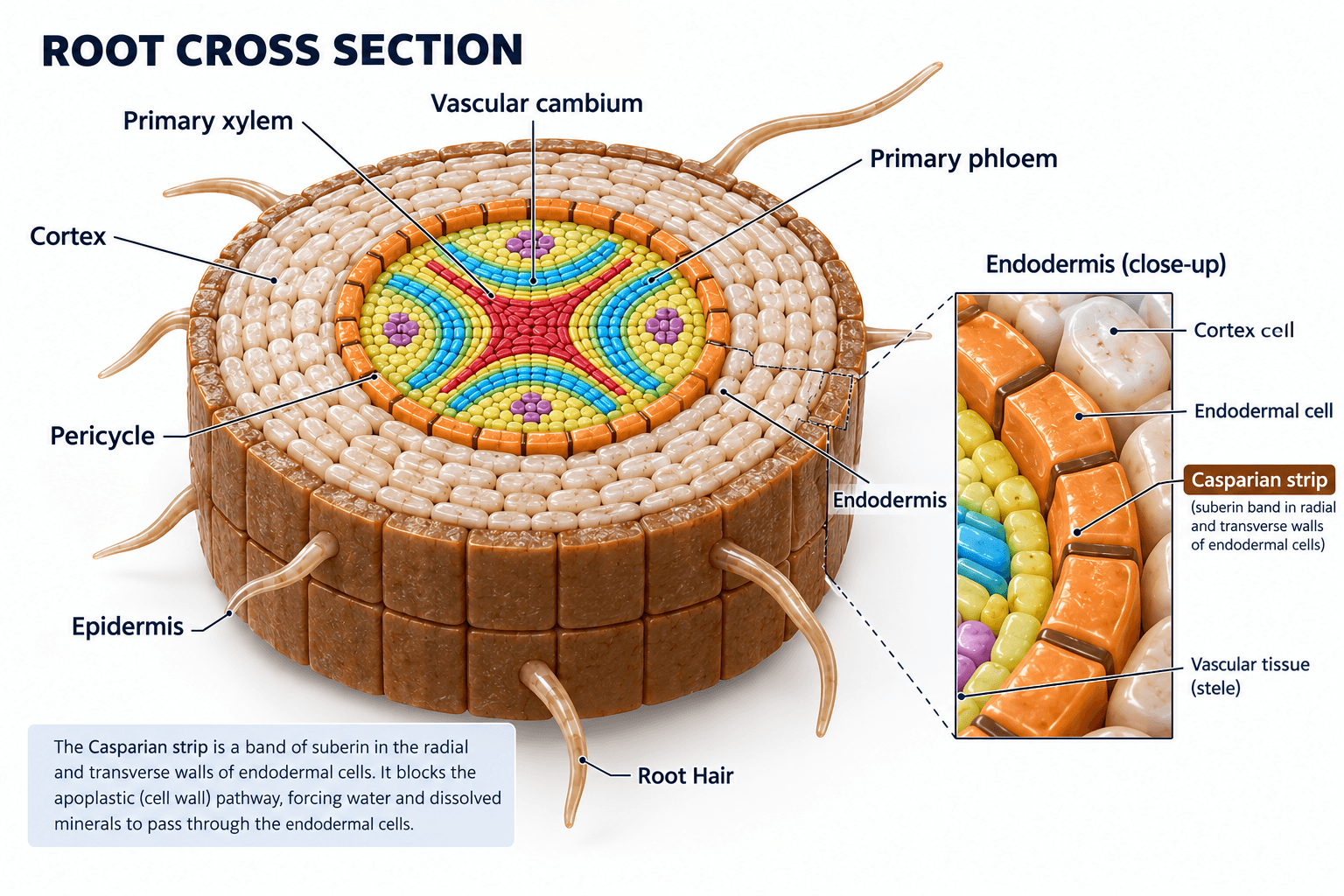
Water and dissolved nutrients surrounding a root can enter through the root surface, particularly through root hairs. From there, they move through several layers of root tissue toward the center of the root.
There are two general pathways:
Apoplastic pathway: water and dissolved substances move through the spaces between cells and along cell walls.
Symplastic pathway: substances enter cells and move from one cell to another through connections called plasmodesmata.
As water moves inward, it eventually reaches the endodermis.
This is where the root's filtering system becomes particularly important.
The Casparian strip: the barrier
Endodermal cells contain a specialized structure called the Casparian strip.
The Casparian strip is a band of hydrophobic material, primarily suberin, deposited in the radial and transverse walls of endodermal cells.
Its important function is to block uncontrolled movement through the cell walls.
Instead of simply continuing through the spaces between cells, water and dissolved ions must cross the plasma membrane of an endodermal cell.
This gives the plant an opportunity to regulate what enters the vascular system.
In simple terms:
Root zone → root hairs → cortex → endodermis → xylem → plant
The endodermis is the checkpoint along this pathway.
Why this matters for nutrients
Plants require nutrients in specific ionic forms.
For example, nitrogen can be absorbed primarily as nitrate (NO₃⁻) or ammonium (NH₄⁺), while other essential elements are taken up as ions such as potassium (K⁺), calcium (Ca²⁺), magnesium (Mg²⁺) and phosphate species.
The concentration of a nutrient in the root zone therefore does not automatically equal the amount that enters the plant.
The plant controls uptake using membrane proteins, ion channels and transporters.
This means that root-zone conditions influence the plant at several levels:
pH affects the chemical form and availability of nutrients.
Electrical conductivity (EC) reflects the concentration of dissolved ions.
Oxygen availability affects root respiration and active nutrient transport.
Temperature affects biological and chemical processes around the root.
Water availability affects transport of nutrients toward the root.
Excess salts can make water uptake more difficult through osmotic effects.
The endodermis is therefore part of a larger system in which the plant continuously manages the movement of water and nutrients.
The root is not a passive pipe
It is tempting to think of a root as a pipe that simply absorbs whatever is available.
In reality, the root is a highly selective biological interface.
The root zone provides the chemical environment. The root senses and responds to that environment, and specialized transport mechanisms regulate the movement of substances into the plant.
The endodermis helps maintain this separation between the external environment and the plant's internal transport system.
This is particularly important because the composition of the root-zone solution can change continuously.
After irrigation or fertilization, nutrient concentrations may rise. As plants absorb water and ions, they change again. Microbial activity, evaporation, temperature and chemical reactions can further alter the root-zone environment.
Why root-zone monitoring matters
For modern controlled agriculture, measuring the root-zone environment can therefore provide valuable information about the conditions in which nutrient uptake occurs.
Parameters such as:
pH · EC · temperature · dissolved oxygen · moisture
can describe important aspects of the environment surrounding the roots.
However, these measurements should not be interpreted as a direct measurement of nutrient uptake. To start measuring your water parameters check out our sensors and sensor box monitoring station
A high concentration of a nutrient in the root zone does not necessarily mean that the plant is absorbing it efficiently. Uptake depends on the plant's physiological state, nutrient form, environmental conditions and interactions between different ions.
The goal of root-zone management is therefore not simply to maximize nutrient concentration.
It is to maintain an environment in which the roots can function effectively.
From water quality to plant performance
The endodermis provides a useful reminder that water quality and plant nutrition are closely connected.
Before nutrients can become part of plant tissue, they must first move through the root environment and pass through multiple biological barriers.
Waboost focuses on controlling and monitoring the conditions around this process.
By combining water treatment, oxygenation, sensing and data monitoring, the root-zone environment can be observed and managed rather than treated as a black box.
The root ultimately decides what enters the plant.
Our job is to provide the root with the conditions it needs to make that process work efficiently.