written by

Subscribe to our monthly water newsletter
We might send you an email if we have something news worthy, written by our water professionals
This article explains the physics, gives a full saturation table, and covers what it means for aquaculture, hydroponics, irrigation and ponds. It also explains why you can put far more oxygen into water than air alone allows.
The physics: why temperature controls oxygen solubility
Oxygen is only lightly soluble in water. O₂ molecules are non-polar and are held in solution by weak intermolecular forces, not chemical bonds. Water molecules arrange themselves around each dissolved O₂ molecule, and forming that arrangement releases a little energy. In other words, dissolving oxygen is exothermic.
Le Chatelier's principle says that when you add heat to a system in equilibrium, the equilibrium shifts in the direction that absorbs heat. For dissolved oxygen, that direction is oxygen leaving the water. There is also a simple molecular picture. In warmer water, dissolved oxygen molecules carry more kinetic energy, so more of them have enough energy to break free and escape at the surface. The weak forces holding them in solution matter less.
The result is that every rise in water temperature lowers the maximum amount of oxygen the water can hold in equilibrium with air. This maximum is called the saturation concentration.
Where Henry's Law fits in
Henry's Law states that the amount of gas dissolved in a liquid is proportional to that gas's partial pressure above the liquid:
C = k_H × p
Temperature doesn't appear in the law itself. It changes the constant k_H, which falls as water warms. That is the effect described above.
The partial-pressure part of the law matters just as much, and it is often overlooked. Air is only about 21% oxygen. If the water is exposed to a gas with more oxygen than air, the saturation limit rises in proportion. We come back to this below.
How much oxygen does water hold at each temperature?
Freshwater saturated with air at sea level (760 mmHg), in mg/L:
°C | mg/L | °C | mg/L | °C | mg/L |
|---|---|---|---|---|---|
0 | 14.6 | 12 | 10.8 | 24 | 8.4 |
1 | 14.2 | 13 | 10.5 | 25 | 8.3 |
2 | 13.8 | 14 | 10.3 | 26 | 8.1 |
3 | 13.5 | 15 | 10.1 | 27 | 8.0 |
4 | 13.1 | 16 | 9.9 | 28 | 7.8 |
5 | 12.8 | 17 | 9.7 | 29 | 7.7 |
6 | 12.4 | 18 | 9.5 | 30 | 7.6 |
7 | 12.1 | 19 | 9.3 | 31 | 7.4 |
8 | 11.8 | 20 | 9.1 | 32 | 7.3 |
9 | 11.6 | 21 | 8.9 | 33 | 7.2 |
10 | 11.3 | 22 | 8.7 | 34 | 7.1 |
11 | 11.0 | 23 | 8.6 | 35 | 7.0 |
Values based on the Benson & Krause (1984) equations used in USGS DO tables.
The pattern is steep at low temperatures and flatter at high ones, but the loss is significant across the whole range. Warming from 10°C to 30°C cuts oxygen capacity by about a third. Warming from 20°C to 30°C cuts it by about 17%.
Two other factors shift these numbers:
Salinity. Dissolved salts reduce oxygen solubility. Full-strength seawater holds roughly 19% less oxygen than fresh water at the same temperature, about 7.4 mg/L at 20°C. Marine and brackish aquaculture systems start with less headroom.
Altitude. Lower air pressure means lower oxygen partial pressure. Saturation drops by roughly 1.2% per 100 m of elevation near sea level. At 500 m it is about 94% of the sea-level value, and at 1,000 m about 89%.
Warm water also uses oxygen faster
The saturation limit is only half the story. Fish, invertebrates, bacteria, algae and plant roots are mostly cold-blooded or temperature-dependent. For many of them, metabolic rate roughly doubles with every 10°C rise.
In warm water, fish breathe harder and use more oxygen per kilogram. Bacteria decompose organic matter such as feed, manure and dead algae faster, and they consume oxygen as they do it. Roots respire faster and need more oxygen to keep taking up nutrients. Pathogens and biofilms grow faster, adding further demand.
So warm water carries less oxygen while more is being consumed. This is why DO crashes cluster in summer. They are most severe in closed, heavily stocked or nutrient-rich systems, where oxygen demand can exceed what the surface can resupply from the air.
What it means in practice
Aquaculture and ponds
Oxygen stress in fish shows up long before a visible kill. Reduced feeding, poorer feed conversion, slower growth and higher disease susceptibility typically appear as DO falls toward about 5 mg/L. Coldwater species such as trout are usually kept above roughly 6–7 mg/L. Many warmwater species survive lower levels but still grow worse.
In outdoor ponds, the most dangerous moment is usually just before dawn. During the day, algae photosynthesise and add oxygen. At night, everything only consumes it. A hot, still night after a cloudy day, with little photosynthesis to build a buffer, is the classic setup for a summer fish kill.
→ See our aquaculture and lakes & ponds pages.
Hydroponics and irrigation
Plant roots need oxygen for respiration. Respiration powers active nutrient uptake. When DO falls, roots become energy-starved, nutrient uptake slows, and root tissue becomes more vulnerable.
Warm, low-oxygen water also favors Pythium and other root-rot pathogens. Many growers aim to keep nutrient solutions below roughly 22–24°C for this reason. Above that range, the combination of lower oxygen, higher root demand and faster pathogen growth sharply raises the risk.
Can you get more oxygen into warm water than air allows?
Yes, and this is where Henry's Law works in your favor.
Water in contact with air can only reach the saturation values in the table. That limit comes from air's roughly 21% oxygen content, not from water itself. If you dissolve pure oxygen instead of air, the partial pressure rises almost fivefold, and so does the saturation limit. At 20°C, water in equilibrium with pure oxygen can hold about 43 mg/L instead of 9.1 mg/L.
In practice, you don't need to reach that ceiling. Supplying oxygen-enriched gas efficiently lets you keep DO at healthy levels in water that is too warm to manage it on its own. You can even keep the water moderately supersaturated. Two factors determine how well this works:
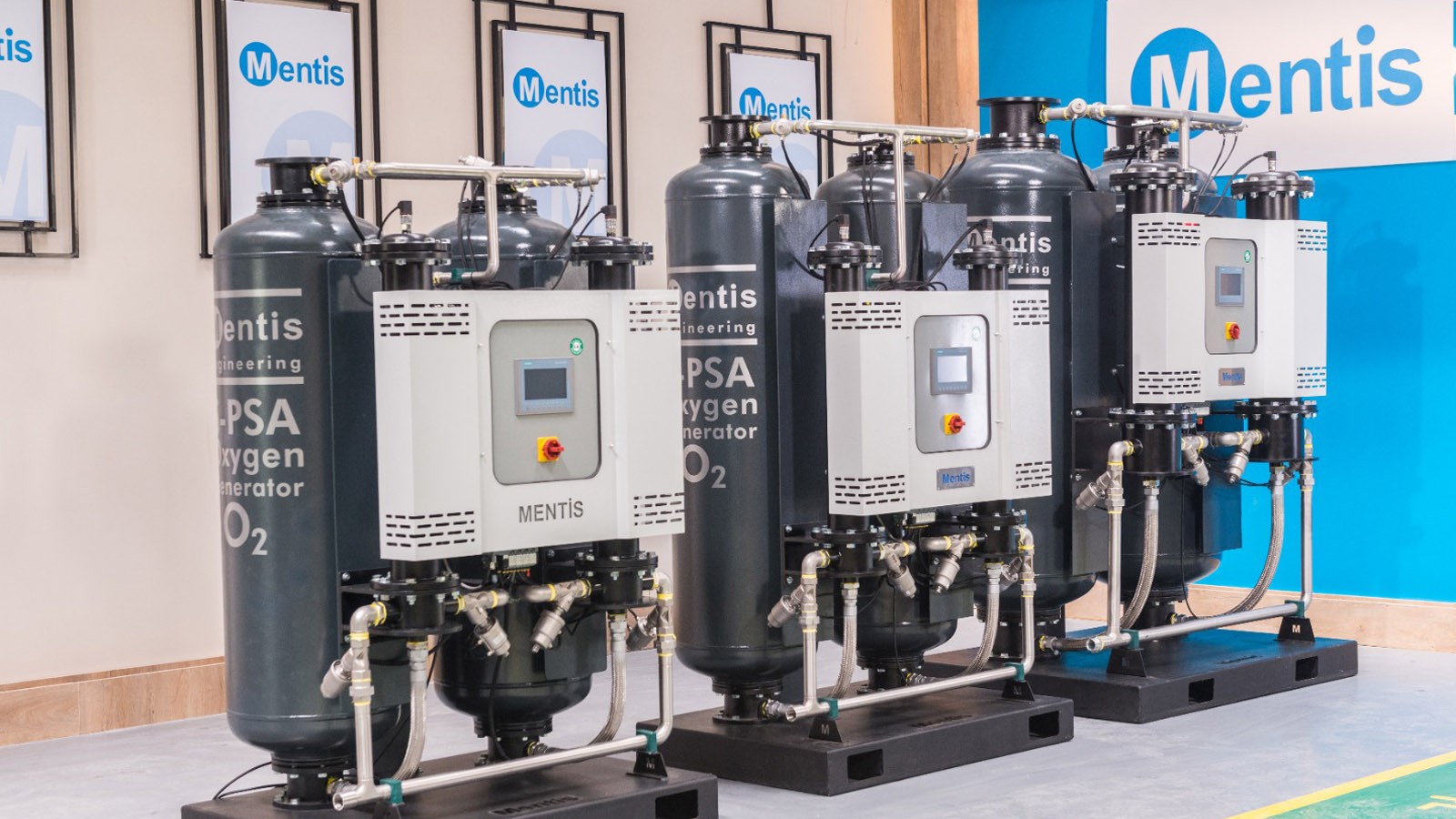
Oxygen source. On-site oxygen generators using pressure swing adsorption (PSA) produce concentrated oxygen from ambient air. See how an oxygen generator with sieve beds works.
Bubble size. Large bubbles rise quickly and burst at the surface, so much of the gas escapes undissolved. Smaller bubbles offer far more surface area per unit of gas and rise more slowly, so they transfer more oxygen before reaching the surface. Ultrafine bubbles, often called nanobubbles, take this furthest. Learn more about ultrafine bubbles.
One caveat: water that is supersaturated relative to air will slowly release its excess oxygen at an open surface. Oxygenation in open systems is therefore a continuous process, not a one-off treatment.
What about cooling the water?
Cooling raises the saturation limit, and in small reservoirs or recirculating systems it can be worthwhile. The effect is modest, though. Dropping from 25°C to 20°C raises capacity by about 10%. Cooling also doesn't add oxygen on its own; it only raises the ceiling that aeration or oxygenation can then fill. Chilling large volumes of water is energy-intensive, and it is often impractical for ponds, irrigation lines or outdoor tanks. For most operations, cooling where it's cheap and oxygenating where it isn't is the more realistic strategy.
Measure it: mg/L vs % saturation
Because saturation depends on temperature, a DO reading means little unless you know the temperature too. Most DO sensors report both:
mg/L is the absolute amount of oxygen available to fish and roots. This is the number biological thresholds refer to.
% saturation is how full the water is relative to its limit at the current temperature, salinity and pressure. 100% at 30°C is still only about 7.6 mg/L.
A pond can read a healthy 95% saturation on a hot afternoon and still be close to stress levels in mg/L. Logging DO and temperature continuously, rather than taking a single spot reading, is the only reliable way to catch pre-dawn lows and heat-driven drops before they cause losses.
→ Waboost water sensors log DO and temperature continuously and stream the data to the Waboost Cloud with alerts.
Frequently asked questions
Does hot water have no oxygen at all?
No. Water at 35°C in contact with air still holds about 7 mg/L. Boiling drives most dissolved gas out, but ordinary warm water always contains some oxygen. It just holds less than cold water.
Why does cold water hold more oxygen?
Dissolving oxygen releases heat, so lower temperatures favour oxygen staying dissolved. Dissolved oxygen molecules in cold water also have less energy to escape.
What is a safe dissolved oxygen level for fish?
It depends on species. As a rough guide, most farmed fish perform best above about 5 mg/L, and coldwater species such as trout above about 6–7 mg/L.
Can water hold more than 100% dissolved oxygen?
Yes. Photosynthesis on sunny days or oxygenation with concentrated oxygen can supersaturate water relative to air. Without continued input, the excess gradually escapes at the surface.
Conclusion
Warm water holds less dissolved oxygen for two reasons. Oxygen dissolution is exothermic, so higher temperatures shift the equilibrium toward the gas phase, and warmer molecules escape the surface more easily. Warm conditions also speed up oxygen consumption by every organism in the water. The result is a shrinking supply meeting growing demand, which explains summer fish kills, root rot in warm reservoirs, and heat-stressed crops.
Air sets the ceiling on dissolved oxygen, but it doesn't have to. By measuring DO continuously and delivering concentrated oxygen in bubbles small enough to dissolve efficiently, you can keep oxygen levels healthy even when the water is warm.
Sources: Benson, B.B. & Krause, D. (1984), Limnology and Oceanography 29(3), 620–632; USGS Office of Water Quality, DOTABLES; APHA Standard Methods for the Examination of Water and Wastewater, 4500-O.