written by

Subscribe to our monthly water newsletter
We might send you an email if we have something news worthy, written by our water professionals
What is Corona Discharge?
Corona discharge is a process where a high voltage is applied across a gas (usually air or oxygen) to create a small, stable electrical arc. This arc doesn’t fully bridge the gap between electrodes but ionizes the gas in its immediate area, creating a plasma. This plasma contains highly energetic electrons capable of splitting oxygen molecules (O₂) into individual oxygen atoms.
How Ozone is Formed
The basic chemical reaction for ozone formation is:

Here’s what happens inside a corona discharge ozone generator:
Oxygen Supply: The generator takes in dry air or pure oxygen. Moisture is avoided because water can interfere with ozone formation and damage the generator.
High Voltage Application: A high-voltage AC or pulsed DC is applied across electrodes separated by a dielectric material (usually glass, ceramic, or Teflon). This creates the corona discharge.
Molecular Splitting: Energetic electrons in the corona collide with O₂ molecules, breaking them into individual oxygen atoms (O).
Ozone Formation: These free oxygen atoms quickly react with intact O₂ molecules to form ozone (O₃).
Ozone Output: The ozone-enriched gas exits the generator and is delivered to the desired application, such as an air duct, water tank, or sterilization chamber.
Key Components of a Corona Discharge Ozone Generator
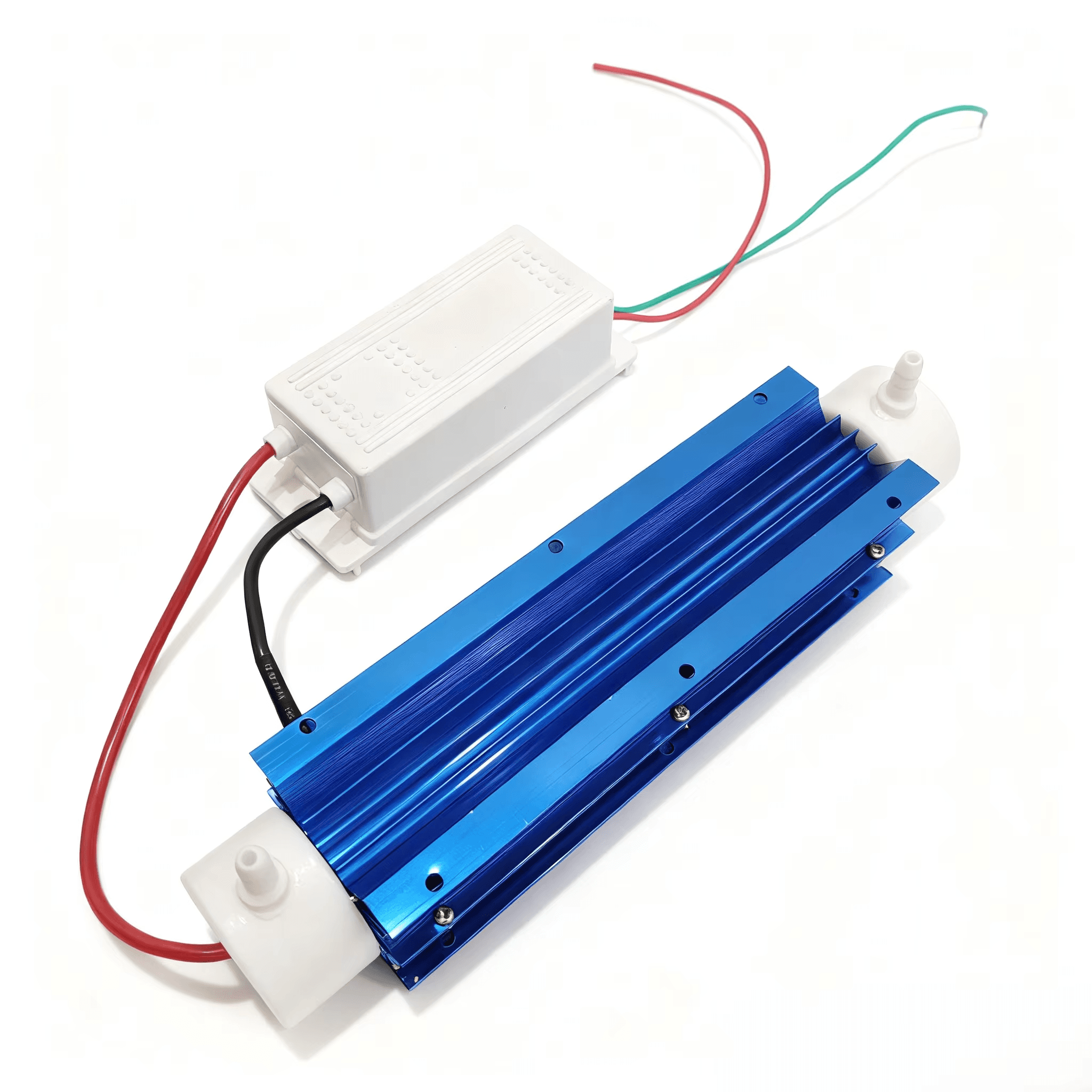
Dielectric Tube or Plate: Insulates the high voltage and helps sustain a uniform corona discharge.
High-Voltage Transformer: Provides the energy needed to generate the corona.
Electrodes: Usually metal plates or rods, where one is connected to high voltage and the other to ground.
Oxygen Source: Dry air or pure oxygen ensures efficient ozone production. Nearly pure oxygen is produced by an oxygen generator built-into Waboost machines.
Cooling System: Ozone generation produces heat, and cooling helps maintain efficiency and prevents breakdown of ozone back into oxygen.
Conversion Efficiency and Why We Use Oxygen
The efficiency of ozone generation, often called conversion efficiency, depends on how many O₂ molecules are successfully converted into O₃. Using pure oxygen instead of ambient air greatly improves this efficiency because nitrogen and other gases in air absorb energy without forming ozone, reducing output. By feeding the generator with concentrated oxygen from an oxygen generator, we achieve higher ozone concentrations with less energy, making the system more effective and cost-efficient. This is especially important for industrial applications where high ozone output is required for water treatment.
Typical Conversion Efficiency
In practical corona discharge systems, the conversion efficiency usually ranges between 10% and 16% when using pure oxygen. This means that roughly one-fifth of the oxygen molecules are converted into ozone under optimal conditions. Efficiency is affected by factors such as gas flow rate, humidity, temperature, applied voltage, and electrode design. Operating at lower temperatures and with dry oxygen maximizes ozone yield, which is why oxygen generators are preferred for high-performance applications.
Advantages of Corona Discharge
Can operate continuously for long periods.
More energy-efficient compared to UV ozone generation for larger systems.
Scalable for industrial or commercial use.