written by

Subscribe to our monthly water newsletter
We might send you an email if we have something news worthy, written by our water professionals
As water-treatment plants, aquaculture facilities, greenhouses, and industrial installations become more automated, the way sensors communicate becomes just as important as the measurement itself.
For many manufacturers, Modbus RS485 has become the go-to communication protocol for modern water sensors. The reason is not that Modbus is the newest or most advanced protocol. It is that it offers a practical combination of simplicity, reliability, flexibility, and compatibility with industrial equipment.
From a Simple Signal to a Complete Measurement
Traditional sensors often communicate using an analog signal, such as 4–20 mA. The principle is straightforward: the current represents a measured value.
For example:
4 mA → 0 mg/L dissolved oxygen
20 mA → 20 mg/L dissolved oxygen
This approach is robust and still widely used. However, it has limitations. A single analog signal normally represents one measurement, and the receiving controller must interpret that signal.
A modern digital water sensor can provide much more:
Measured value
Measurement unit
Sensor temperature
Internal diagnostics
Calibration information
Sensor status
Measurement quality
Multiple parameters from one device
Configuration and calibration functions
Instead of sending only a number, the sensor can communicate a structured set of information.
Modbus makes this possible without requiring a complicated communication system.
What Is Modbus?
Modbus is an industrial communication protocol originally developed for programmable logic controllers. It defines how devices exchange data using a simple request-and-response structure.
A typical system contains:
Master / client: PLC, industrial computer, or monitoring system
Slave / server: Sensor or other field device
Communication interface: Usually RS-485 for field installations, but can also go over RJ45 with Modbus TCP
The controller sends a request such as:
“Read the dissolved oxygen value from sensor address 3.”
The sensor responds with the requested data.
Another request might ask:
“Read the temperature, sensor status, and calibration information.”
The communication itself is simple, but the amount of information that can be exchanged is much greater than with a single analog signal.
Why RS-485 + Modbus Is So Popular
Modbus can operate over different physical interfaces, but Modbus RTU over RS-485 is especially common in water-quality sensors.
1. Long Cable Distances
Water sensors are often installed far away from the control cabinet.
A sensor may be:
In a pond
Inside a water reservoir
At the outlet of a wastewater treatment process
In a greenhouse irrigation system
On a pipeline several dozen meters from the controller
RS-485 is designed for industrial communication over relatively long cable distances and is much more suitable for these installations than many short-distance communication interfaces.
2. Multiple Sensors on One Cable
One of the biggest advantages of Modbus RTU is that multiple sensors can share the same communication bus.
For example, a single RS-485 line could connect:
Dissolved oxygen sensor
pH sensor
ORP sensor
Conductivity sensor
Turbidity sensor
Water temperature sensor
Each device has its own Modbus address.
The controller can communicate with them individually:
Sensor 1 → DO
Sensor 2 → pH
Sensor 3 → ORP
Sensor 4 → Conductivity
This reduces wiring and makes the installation easier to expand. With analog sensors, every measurement typically requires its own signal input and dedicated wiring.
In Waboost we ship all of our machines and sensor boxes with M12 splitter, that allows you to chain sensors as much as you need.
3. More Than One Measurement Per Sensor
Some modern water sensors measure more than one parameter.
For example, a conductivity sensor may also provide:
Temperature
Conductivity
Salinity
TDS
Compensation information
A dissolved oxygen sensor may provide:
Dissolved oxygen concentration
Oxygen saturation
Temperature
Sensor diagnostics
With Modbus, all of these values can be transmitted through the same communication connection.
This is particularly useful when the sensor performs internal calculations or compensation.
The controller does not need to recreate every calculation itself. It can simply read the values produced by the sensor. You can find all parameters on our sensor box configurator page.
4. Digital Communication Avoids Analog Signal Limitations
Analog signals are useful, but they introduce several practical considerations:
Signal conversion
Electrical noise
Grounding
Cable resistance
Analog input accuracy
Scaling
One signal per measurement
A 4–20 mA signal also does not inherently tell the controller whether the sensor is operating correctly.
For example, a signal corresponding to 7.2 mg/L could mean:
The water actually contains 7.2 mg/L oxygen
The sensor is measuring incorrectly
The sensor is disconnected and the input is being interpreted incorrectly
The sensor has a calibration problem
Digital communication can provide the measurement together with status and diagnostic information.
This does not make Modbus immune to wiring problems, but it gives the controller more information to identify them.
5. Sensor Configuration Becomes Easier
Modern sensors are increasingly configurable.
Depending on the manufacturer, Modbus may allow the controller to:
Read measurement values
Change measurement units
Configure measurement ranges
Set sensor addresses
Adjust communication parameters
Read calibration data
Start calibration procedures
Read diagnostic information
For example, a monitoring system could identify a sensor and retrieve its configuration automatically.
This is much more flexible than treating every sensor as a simple analog input.
6. Calibration and Maintenance Data Can Be Digital
Water sensors require maintenance and calibration. In many installations, knowing the measurement is not enough. The system also needs to know whether the sensor is trustworthy.
A digital sensor may expose information such as:
Last calibration date
Calibration coefficients
Sensor operating hours
Internal temperature
Error codes
Measurement status
Sensor identification
This allows a monitoring platform to build a more complete history of the sensor.
For example, a system could record:
Dissolved oxygen: 8.2 mg/L
Temperature: 22.4 °C
Sensor status: OK
Last calibration: 14 August 2026
The measurement and its context travel together.
7. Modbus Is Widely Supported
Another reason Modbus remains popular is its compatibility.
It is supported by a wide range of equipment:
PLCs
Industrial computers
SCADA systems
Remote I/O modules
HMIs
Data loggers
Gateways
Embedded Linux systems
Cloud-connected monitoring stations
A water sensor manufacturer does not need to develop a completely different communication system for every automation platform.
Likewise, a system integrator can often connect sensors from different manufacturers using the same general communication method.
Modbus is not limited to one PLC brand or one automation ecosystem.
8. It Fits Modern Linux-Based Monitoring Systems
Modern monitoring systems increasingly use industrial computers running Linux rather than relying exclusively on traditional PLC architectures.
This makes Modbus particularly attractive.
A Linux-based system can communicate with Modbus sensors using standard libraries and interfaces. The same computer can also:
Store historical measurements
Run a local web interface
Process sensor data
Connect to the cloud
Manage alarms
Provide remote access
Integrate with databases and APIs
The sensor does not need to know whether the receiving system is a Siemens PLC, a Linux computer, or a custom monitoring platform.
It simply communicates using Modbus. This separation between the sensor and the software platform makes the overall system more flexible.
9. Modbus Makes Sensor Replacement Easier
In real installations, sensors eventually need to be replaced.
With a well-designed Modbus system, replacing a sensor can be relatively straightforward:
Connect the new sensor.
Verify the measurement.
Return the system to operation.
The monitoring software can be designed to identify sensors by their configuration rather than requiring a completely new software implementation for every physical device.
This is especially useful when a system supports sensors from multiple manufacturers.
10. Modbus Is Simple Enough to Remain Reliable
Modbus does not attempt to solve every problem.
It is not a complete industrial networking architecture. It does not inherently provide encryption, authentication, or advanced device discovery.
However, its simplicity is also one of its strengths.
A basic Modbus RTU system is relatively easy to:
Understand
Wire
Test
Diagnose
Implement
Maintain
For water-quality monitoring, where sensors may operate continuously in demanding environments, simple and predictable communication is often more valuable than unnecessary complexity.
Modbus Is Not Perfect
Modbus also has limitations.
For example:
Modbus RTU is generally a master-controlled request/response system.
Devices usually need manually configured addresses.
Register maps differ between manufacturers.
Data types and scaling must be documented.
RS-485 wiring must be installed correctly.
Standard Modbus RTU does not provide encryption.
Therefore, using Modbus does not automatically make a system plug-and-play.
The quality of the implementation still depends on the sensor manufacturer and the monitoring software.
A good system should provide clear documentation, reliable error handling, and a flexible way to configure sensors. Our development team in Waboost made sure that you have none of the above configuration. We provide simple Plug & Play experience for our customers. Also all sensors are shipped with IP67 M12 connector, so you never need to crimp, screw or mess with any wiring.
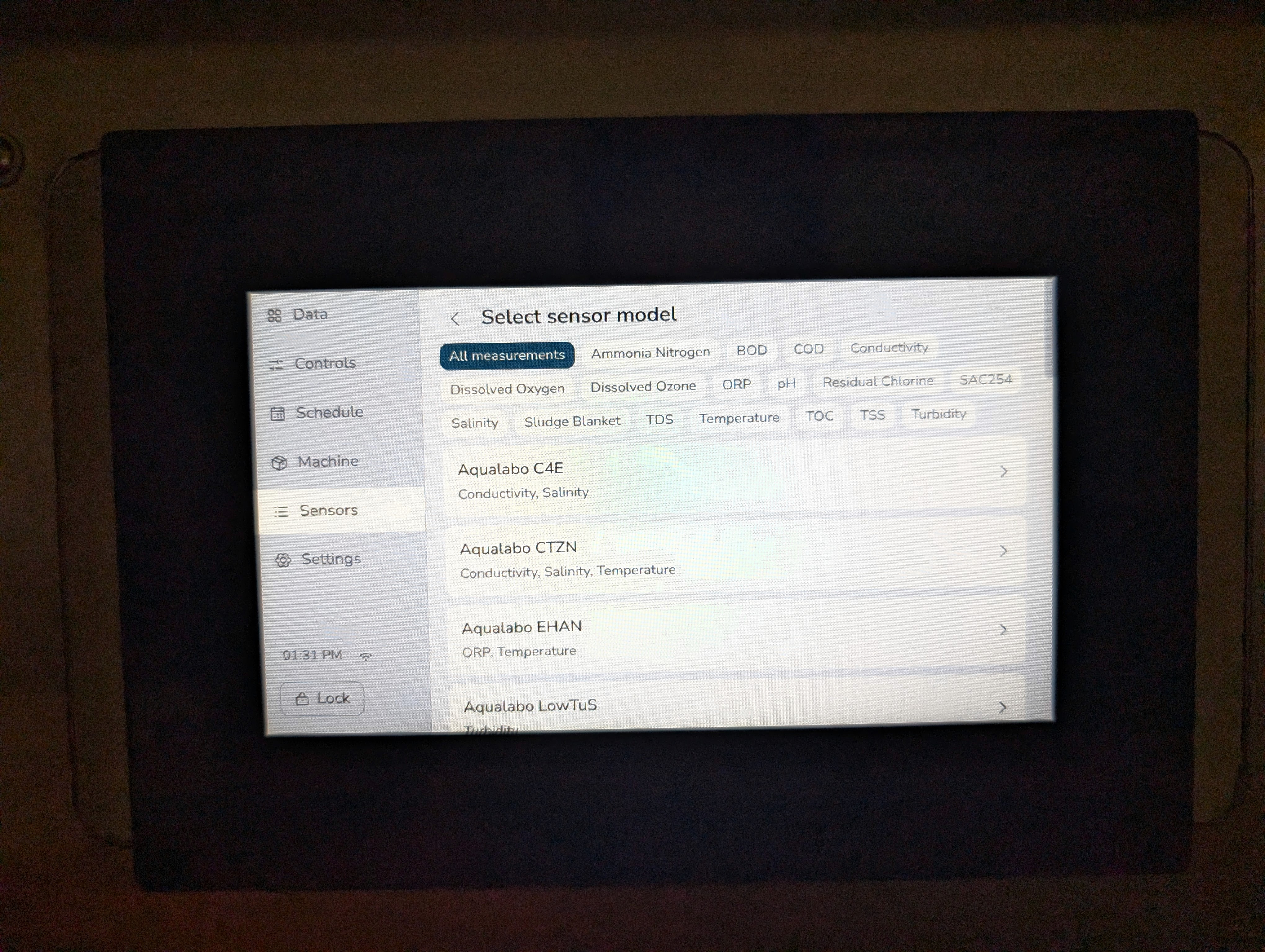
The Importance of a Good Sensor Integration Layer
The real advantage of Modbus becomes apparent when the monitoring software is designed correctly.
At Waboost, we have already built our system around this principle. Instead of hardcoding every sensor into the application, our software maintains a configurable sensor map that defines how each sensor communicates and what data it provides.
For example, a sensor configuration can specify:
The software uses this configuration to communicate with the sensor and interpret its measurements. If we add another sensor, we do not need to develop a new software release or hardcode another device into the application. We simply add or update its configuration.
This allows Waboost to support:
Different sensor manufacturers
Different Modbus addresses
Different register maps
Multiple sensors of the same type
Additional measurement parameters
Future sensor models
The protocol remains the same. Only the sensor configuration changes.
This is an important part of our approach to building flexible water-monitoring systems. The hardware can evolve, new sensors can be introduced, and each installation can have a different combination of measurements—without requiring the entire software architecture to change.
Why This Matters for Water Treatment
Water-treatment systems are rarely identical.
One installation may require:
DO + temperature
Another may require:
pH + ORP + conductivity
A larger system may require:
DO + ORP + pH + turbidity + conductivity + temperature
The monitoring platform should not need to be redesigned every time the sensor combination changes.
Modbus provides a common communication foundation, while the software can determine which sensors are installed and what data they provide.
This is particularly important for modular systems that need to scale from a small greenhouse installation to a large wastewater treatment plant.
Conclusion
Modern water sensors use Modbus because it provides a practical way to exchange much more information than a traditional analog signal, while remaining simple enough for industrial installations.
Its main advantages are:
Long-distance communication
Multiple sensors on one bus
Multiple measurements per device
Digital diagnostics
Configuration and calibration access
Broad compatibility
Easy integration with PLCs and Linux systems
Flexible expansion
Modbus is not necessarily the most technologically advanced protocol. It is popular because it solves the actual problems that water-monitoring systems face.
The future of water-quality monitoring is not just about measuring water. It is about connecting sensors, understanding their data, and integrating them into flexible systems. Modbus provides a reliable foundation for doing that.